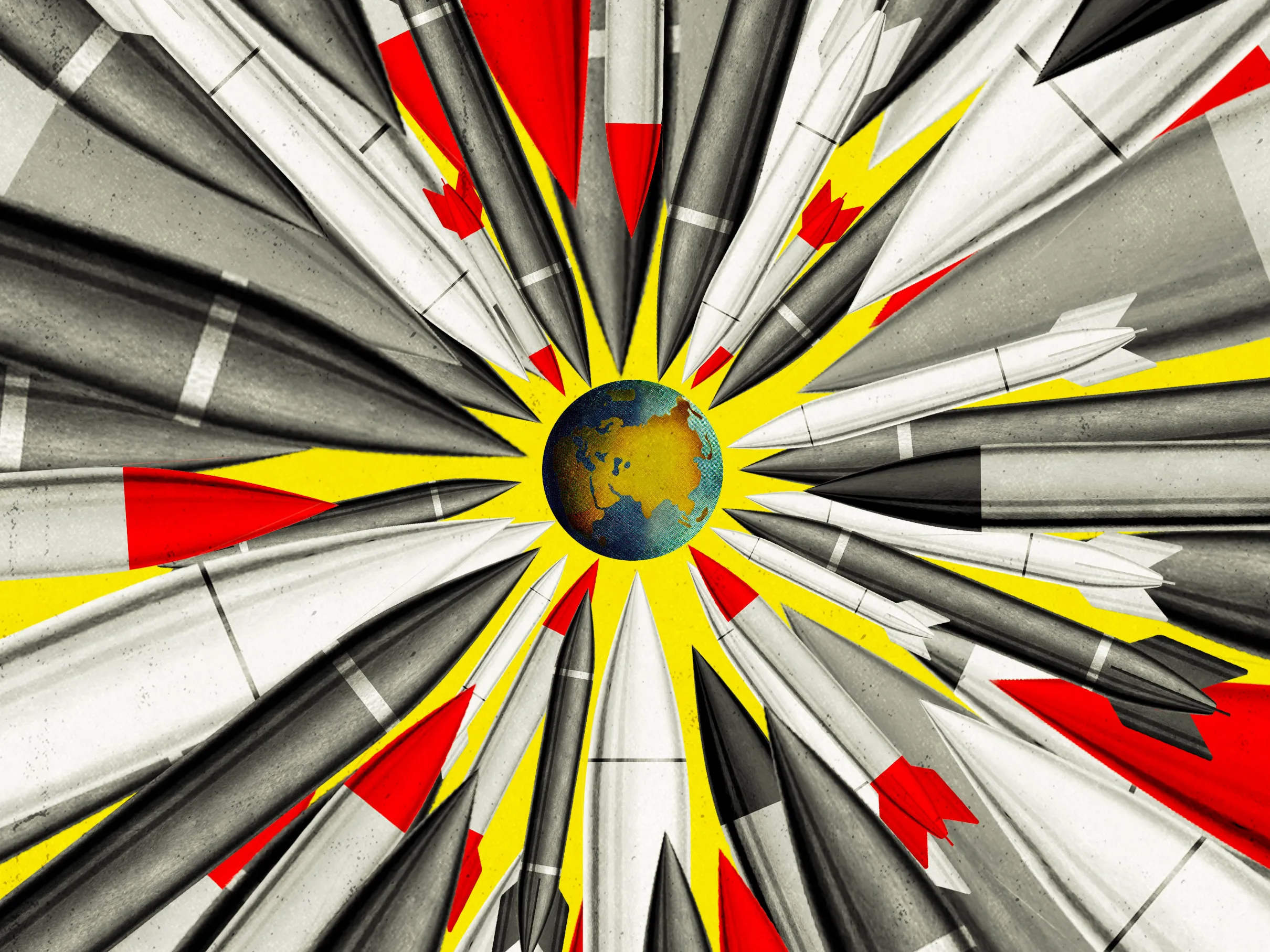
The danger is no longer only whether Iran moves closer to a bomb. It is whether other states conclude that remaining non-nuclear leaves them exposed to coercion, isolation and regime-threatening pressure.
The nuclear question has changed
For decades, nuclear diplomacy rested on a dangerous but familiar assumption: states might threaten, sanction and posture but most would still avoid crossing the line into open nuclear escalation. That assumption now looks weaker.
A recent PGAN podcast with intelligence and security expert Dr. Joseph Fitsanakis raised this question directly but the issue now extends well beyond one conversation.
The confrontation involving Iran, Israel and the United States has exposed a deeper problem than the fate of Iran’s nuclear programme alone. It has raised a harder question for governments watching from the sidelines: does the international system still protect states that remain non-nuclear?
The formal dispute remains centred on uranium enrichment, inspections and sanctions relief. The technical picture is already serious. In its May 2025 report, the International Atomic Energy Agency estimated that Iran held 408.6 kg of uranium enriched up to 60 percent U-235, a level close to weapons grade if enriched further. That matters because the issue is no longer technical alone. It is political and psychological. States are watching how nuclear and non-nuclear adversaries are treated. They are watching who is bombed, who is sanctioned, who is isolated and who is handled with caution.
“The most dangerous lesson of the Iran crisis may not be what Tehran does next. It may be what other states learn from it.”
The North Korea comparison is hard to ignore
The comparison with North Korea is uncomfortable but unavoidable.
Pyongyang has faced sanctions, isolation and repeated confrontation with the United States. Yet because it possesses a nuclear deterrent, it is treated with a level of caution that Iran has not enjoyed. North Korea’s arsenal does not make it legitimate. It does not make it safe in any moral sense. But it changes the cost calculation of military action.
Iran sits on the other side of that comparison. It has faced military pressure, sanctions and direct threats while remaining below the nuclear weapons threshold. For states that feel vulnerable to external coercion, the message may look brutally simple: remaining non-nuclear does not guarantee safety.
This is no longer just theory. Saudi Arabia has long pursued civil nuclear ambitions and recent debate over a potential U.S. Saudi nuclear cooperation framework has raised concerns because the strictest non-proliferation safeguards, including a clear prohibition on uranium enrichment and reprocessing, appear contested. Reuters reported in May 2026 that U.S. lawmakers and non-proliferation advocates criticised the proposed framework for lacking the so-called gold standard protections.
South Korea shows the same pressure from another direction. The issue there is not Iran but alliance credibility. CSIS reported in 2025 that 74 percent of South Korean respondents said their country should acquire nuclear weapons if North Korea is recognised internationally as a nuclear weapons state.
These examples do not prove that a global arms race has already begun. That would be an overstatement. But they do show that nuclear restraint is becoming harder to defend politically when states doubt the reliability of alliances, guarantees and international rules.
The Strait of Hormuz exposed the wider risk
The Iran conflict also showed how quickly a nuclear dispute can become a global economic crisis.
The Strait of Hormuz is not an abstract maritime chokepoint. According to the U.S. Energy Information Administration, flows through the strait in 2024 and early 2025 accounted for more than one quarter of global seaborne oil trade and about one fifth of global oil and petroleum product consumption. Around one fifth of global liquefied natural gas trade also passed through the route in 2024.
That is why the crisis could not remain limited to nuclear sites or regional military calculations. Any serious threat to the strait affects energy prices, shipping insurance, inflation and food security far beyond the Middle East. This is the weakness of modern escalation planning. Governments may enter a confrontation with narrow objectives but global interdependence quickly expands the battlefield. A strike aimed at nuclear infrastructure can trigger fears in oil markets. A threat in the Gulf can affect households thousands of miles away.
That does not mean Iran should be allowed to use energy routes as leverage without consequence. It does mean policymakers should stop pretending that military pressure can be neatly contained.
Pakistan’s role matters but should not be overstated
Pakistan’s diplomatic visibility during this crisis deserves attention but it should not dominate the argument.
Its relevance comes from geography, nuclear experience and access to multiple capitals. It shares a border with Iran, has security ties with the United States, maintains a close strategic relationship with China and remains connected to Gulf states. That makes Islamabad useful in moments when direct communication becomes politically difficult.
But usefulness is not control. Pakistan cannot determine Tehran’s nuclear choices or Washington’s military calculations. Its role is limited to facilitation, signalling and keeping contact possible when mistrust rises.
That limited role still matters. But this blog’s larger point is not Pakistan’s mediation. It is the wider lesson other states may draw from the crisis: in a harsher security environment, nuclear restraint becomes harder to justify.
A more dangerous lesson
The most serious consequence of the Iran crisis may unfold outside Iran.
If states conclude that nuclear capability is the only dependable shield against coercion, the global non-proliferation regime will face pressure from several directions. Saudi Arabia’s nuclear energy ambitions, South Korea’s growing public debate over an independent deterrent and wider doubts about alliance reliability all point to the same problem: the political case for nuclear restraint is becoming harder to sustain.
This is how arms races begin. Not always through dramatic announcements but through policy reviews, procurement choices, alliance doubts and quiet shifts in national security thinking.
That is why the Iran conflict should not be read only as another Middle Eastern crisis. It is a warning about the credibility of the wider security order.
The question is no longer simply whether Iran moves closer to nuclear weapons. The harder question is whether the way this crisis is handled convinces other states that they cannot afford to remain without them.