A modern state can lose electricity, banking access, communications and public trust before a single soldier crosses its border. Pakistan's security debate still treats war mainly as a battlefield problem while the more dangerous vulnerabilities are growing inside society itself.
The old map of security is incomplete
Pakistan is trained to imagine war through borders. That instinct is understandable. The country's strategic history has been shaped by India, Afghanistan, nuclear deterrence and repeated military crises. But the next serious security shock may not begin with tanks or aircraft. It may begin with a grid failure, a cyberattack on financial systems, a hospital network going down, a false video spreading during a crisis or a breakdown in communications when public trust is already weak.
That is the uncomfortable lesson of modern conflict.
Ukraine shows the point clearly. Russia did not only fight Ukrainian forces. It repeatedly attacked the systems that allowed Ukrainian society to function. The International Energy Agency reported that over 2022 and 2023 around half of Ukraine's power generation capacity was either occupied, destroyed or damaged and around half of large network substations were damaged by missiles and drones.
The military logic is obvious. A country without reliable electricity, heat, water, hospitals or communications becomes weaker even if its army continues fighting.
Pakistan should not treat this as a European problem. It is a warning.
"A country can defend its border and still fail if the systems behind that border collapse."
The battlefield now runs through daily life
The most important shift is not that infrastructure can be attacked. That has always been true. The shift is that modern societies now depend on complex interlocking systems that are easier to disrupt and far harder to quickly restore.
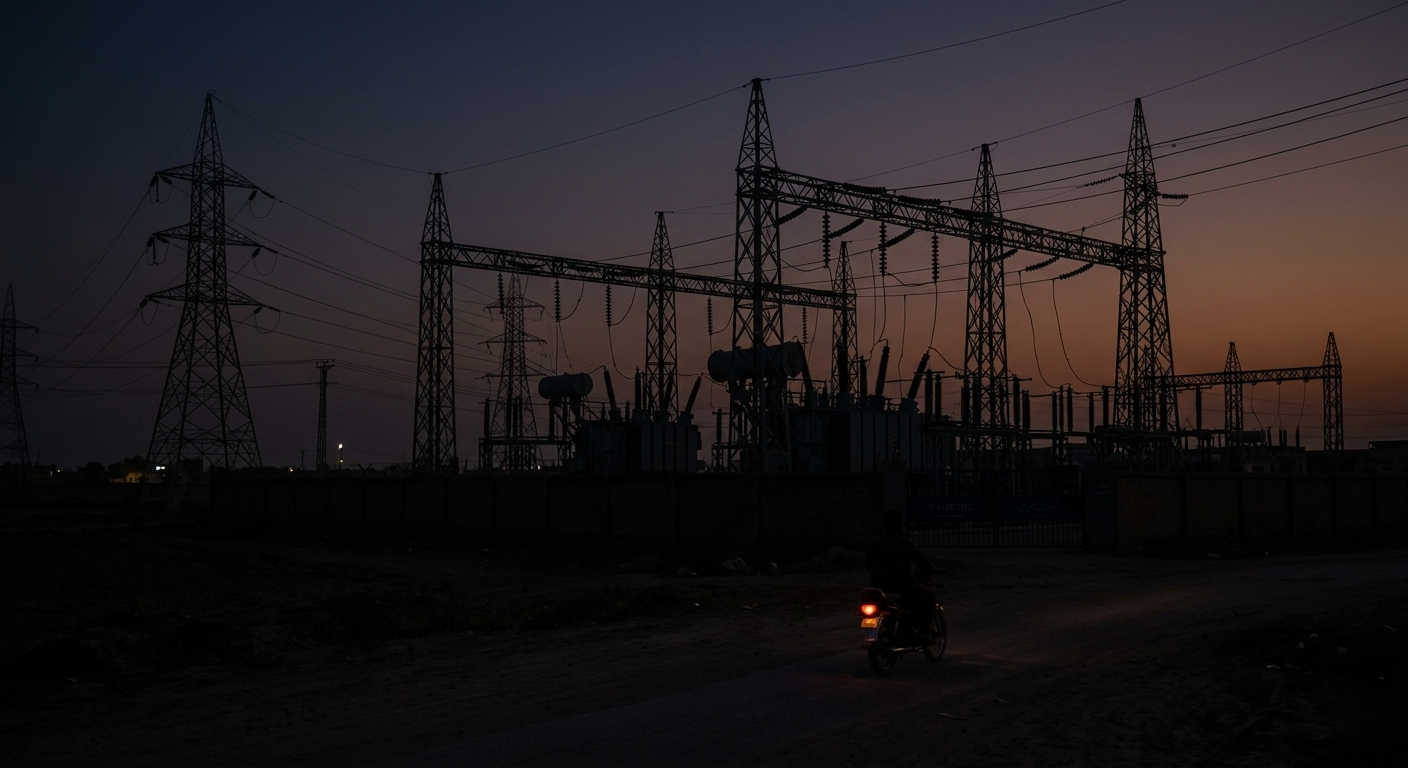
Consider what a sustained power outage actually means in Pakistan today. Hospitals lose refrigeration for medicines and power for equipment. Banking systems go offline. Mobile networks begin failing as backup generators run out of fuel. Water pumping stations stop. Emergency services lose coordination. And public confidence, already fragile, begins to crack.
That cascade is the real threat. Not one failure but the connection between many failures.
The Colonial Pipeline attack in the United States illustrated this at scale. In 2021, a ransomware attack disrupted a pipeline carrying around 45 percent of the fuel consumed on the US East Coast. The result was panic buying, fuel shortages and visible public disruption without a missile being fired or a border being crossed.
Pakistan still underestimates this category of threat. Cybersecurity is treated as a technical department rather than a national security function. Digital records are fragmented. Institutional coordination is inconsistent. Infrastructure resilience is uneven across regions and sectors.
A state with these vulnerabilities is not merely inconvenienced during a crisis. It is exploitable.
Information can now escalate a crisis
In Pakistan's security environment, information disorder may be as dangerous as infrastructure failure and considerably harder to defend against.
During India-Pakistan crises, public emotion routinely moves faster than official verification. Social media rewards outrage before facts are established. Television debate turns uncertainty into certainty within hours. Nationalism becomes a pressure system of its own, pushing leaders toward response before they fully understand what has happened.
This matters with particular urgency because Pakistan and India are nuclear-armed states. In that environment, misinformation is not simply irresponsible speech. It actively compresses decision-making time at precisely the moments when leaders need more of it.
A recent conversation with Professor Alessandro Politi, a senior analyst at NATO Defense College Foundation who specialises in strategic affairs and crisis management, raised a warning directly relevant here: artificial intelligence may not reduce uncertainty in crisis situations but reorganise it. Faster systems do not automatically produce better judgment. They can spread confusion more efficiently, at greater scale, before anyone has the authority or the information to correct it.
The World Economic Forum's Global Risks Report 2025 ranked misinformation and disinformation among the leading short-term global risks, noting their capacity to undermine governance and accelerate instability. Pakistan's problem runs deeper than the global average because institutional trust is already fragile. In a crisis, different citizens will believe different accounts: party channels, military statements, foreign broadcasts, influencers or fabricated videos depending on existing loyalties rather than evidence. That fragmentation is not merely a media problem. It is a strategic vulnerability.
A state that cannot protect public trust cannot fully control escalation.
Security now begins inside society
Pakistan does not need to abandon traditional defence thinking. Borders still matter. Deterrence still matters. Military readiness still matters.
But they are no longer enough on their own.
The deeper problem is that Pakistan recognises new threats rhetorically while still organising security around older assumptions. Officials speak about cyber threats, hybrid warfare and misinformation. But budgets, institutions, training and public debate still treat these as secondary concerns, footnotes to the main conversation about conventional defence.
That gap is becoming harder to justify.
Modern security now depends on people who rarely appear in national security debates: engineers, grid operators, hospital administrators, software developers, data managers, telecom regulators, cyber analysts and local officials responsible for maintaining the basic functions of daily life. If they are not part of security planning and resource allocation, the state is pretending the battlefield is narrower than it actually is.
A missile launch is easy to explain to the public. A slow cyber compromise of critical systems is not. A border violation is visible and politically legible. A manipulated information campaign spreading across millions of phones is harder to prove, harder to attribute and harder to counter. Governments naturally gravitate toward visible threats because visible threats are easier to mobilise around politically.
But the next major shock may not look like war at first.
It may look like confusion, outage, panic, delay, rumour and institutional silence. A crisis that is already underway before anyone agrees on what to call it.
The real question for Pakistan is therefore not whether it has sufficient weapons to defend itself at the border. The harder question is whether the society behind those weapons is resilient enough, institutionally, digitally and informationally, to function under the pressure of a modern attack that never formally announces itself.
Modern wars may still reach borders. But increasingly they begin inside the systems a country forgot to defend.